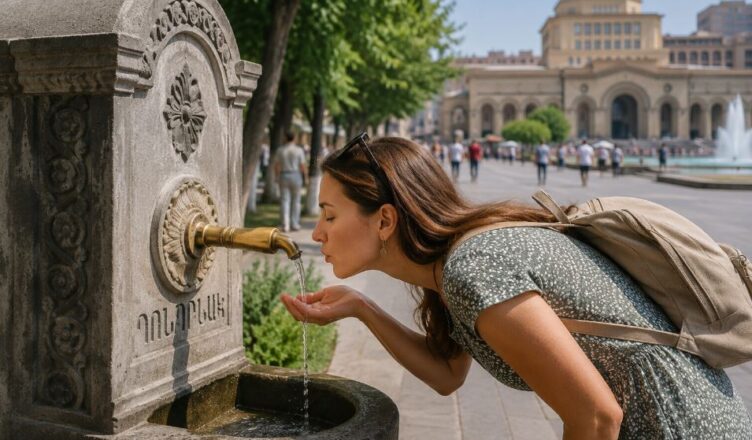
During a summer walk through Yerevan, visitors often notice something unusual. On a busy avenue, beside a quiet park or near an apartment courtyard, someone bends toward a small stone fountain, drinks directly from the stream and continues on their way.
There is no payment terminal, plastic cup or sign advertising bottled water. The fountain simply stands there, offering water to anyone who needs it.
These public drinking fountains are known as pulpulaks, and they are among the most practical and distinctive elements of Armenian urban life. Some are simple and functional. Others are carefully carved from stone, decorated with traditional ornaments or built as memorials.
For residents of Yerevan, a pulpulak may seem like an ordinary part of the street. For a first-time visitor, however, it can reveal something important about the city: here, water is treated not only as a resource, but also as something that should be shared.
What Is a Pulpulak?
A pulpulak is a public drinking fountain commonly found in Yerevan and throughout Armenia. Most are relatively small, often made of stone and designed so that a person can lean forward and drink directly from a continuous stream of water.
The word itself is closely associated with the gentle sound of flowing water. It is commonly explained as coming from the Armenian expression “pul-pul,” which imitates the murmuring or bubbling sound of a spring, combined with a suffix referring to a water source.
The more formal Armenian term is tsaytaghbyur, meaning a fountain or spring from which water flows. In everyday conversation, however, most people simply call it a pulpulak.
Unlike decorative fountains, pulpulaks have a clear practical purpose: they provide drinking water. Their appearance may vary considerably. Some are plain metal or stone structures, while others resemble miniature monuments or pieces of public art.
A Small Fountain With a Long Urban History
Public water sources existed in Yerevan before the modern pulpulak became a familiar part of the city. Yerevan’s first organised water-supply systems began developing in the late nineteenth century, and old neighbourhoods once relied on communal taps and basins for daily water needs.
The form of the pulpulak that people recognise today began appearing on Yerevan’s streets during the early twentieth century, particularly from the 1920s onward. As the capital expanded, these drinking fountains became increasingly common in streets, public squares, parks and residential districts.
Their spread was not only a response to Yerevan’s dry summers. The fountains also reflected an understanding of public space in which basic necessities could be made freely available.
Over time, the pulpulak became so familiar that it stopped feeling like a special attraction. It became part of the background of everyday life: children drinking after playing outside, workers stopping during a hot afternoon and older neighbours filling a small container before returning home.
Why Water Matters So Much in Armenia
Armenia is a mountainous country where natural springs, rivers and underground sources have shaped settlements for centuries. Water has always carried practical importance, but it has also held symbolic meaning.
In Armenian culture, offering water is a simple expression of hospitality. A guest may be offered water before any other refreshment, especially after arriving from the heat or completing a long journey.
The pulpulak brings that private gesture of hospitality into the public street. It offers water without asking who the passer-by is, where they come from or whether they can pay.
This is one reason the fountain feels like more than a piece of infrastructure. It represents an idea: water should be available to the tired pedestrian, the child coming home from school, the elderly neighbour and the traveller discovering the city for the first time.
The Pulpulak as a Memorial
Not every pulpulak was installed only for convenience. Across Armenia, many drinking fountains have been built in memory of a relative, friend, soldier or respected member of a community.
A name, date or short dedication may be carved into the stone. A stranger drinks from the fountain without knowing the person whose memory it preserves, yet the act keeps that person’s name present in everyday life.
According to Armenian tradition, people may offer a kind thought or blessing after drinking from a memorial fountain. In this way, the monument does not simply stand apart from society. It continues to perform a useful service.
This combination of remembrance and generosity gives memorial pulpulaks a special emotional meaning. Instead of creating a monument that people only look at, a family or community creates something from which others benefit.
The memory of one life is connected to the basic need that sustains every life.
Stone, Ornament and Public Art
Many pulpulaks are modest structures, but others demonstrate the skill of Armenian stone carving. Their designs may include geometric patterns, plant motifs, traditional symbols or architectural details reminiscent of churches and khachkars.
Armenian builders have worked with local stone for centuries. Tuff, basalt and other volcanic materials have shaped the appearance of Yerevan, from large public buildings to small courtyard details.
The pulpulak continues this architectural language on a human scale. It may be only about a metre tall, yet its material and ornamentation connect it to the wider visual character of the city.
Some fountains are modern and minimal. Others look as though they belong to an older chapter of Yerevan’s history. Together they form an informal open-air collection of urban design.
Yotnaghbyur: The Seven Springs of Republic Square
One of Yerevan’s best-known drinking-fountain compositions is located near the museum buildings on Republic Square.
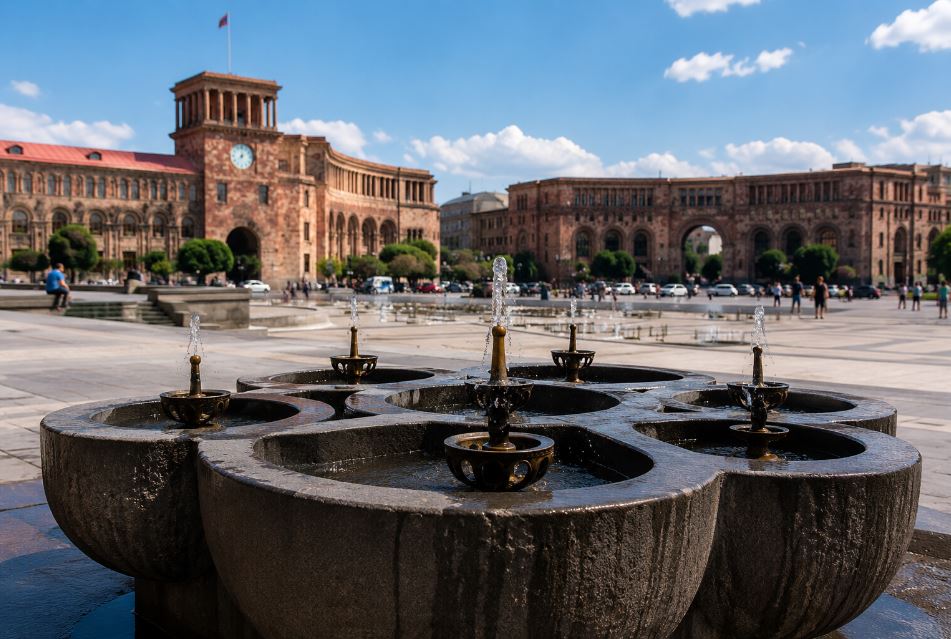
It is called Yotnaghbyur, which means “Seven Springs.” As its name suggests, the structure consists of seven drinking fountains arranged together.
The composition was installed during the Soviet period and became a familiar meeting point in the centre of the capital. It also demonstrates how a practical source of drinking water can be incorporated into a major architectural space rather than hidden away as a purely technical feature.
Visitors often focus on Republic Square’s grand buildings and evening musical fountains. Yet Yotnaghbyur offers a smaller and more intimate encounter with water—one intended not for spectacle, but for drinking.
How Locals Drink From a Pulpulak
Using a traditional pulpulak is simple, although the technique may look unfamiliar at first.
The water usually rises or curves from a small metal outlet. People lean toward the stream and drink without touching the outlet with their mouth. Depending on the design, the flow may be constant or controlled by a tap or button.
Visitors should avoid placing their lips directly on the metal spout. It is better to keep a small distance and drink from the flowing arc of water.
Some people carry reusable bottles and fill them at suitable fountains. However, the design of certain pulpulaks makes direct drinking easier than filling a large container.
Is the Water Safe to Drink?
A functioning pulpulak specifically intended as a drinking fountain is generally connected to a potable water supply. These fountains are widely used by local residents, particularly during Yerevan’s hot summer months.
Still, visitors should use ordinary judgement. Not every structure containing water is a drinking fountain. Decorative fountains, irrigation outlets and damaged pipes should never be treated as pulpulaks.
Before drinking, check that the structure is clearly designed for that purpose, that the water is flowing normally and that the area around the outlet appears clean and maintained.
If a fountain looks damaged, has stagnant water, carries a warning notice or appears not to be in regular use, it is sensible to choose another source. Travellers with sensitive health conditions may also prefer bottled or filtered water.
The key distinction is simple: a real pulpulak is designed for drinking, while many other public water features are not.
Where Can Visitors Find Pulpulaks in Yerevan?
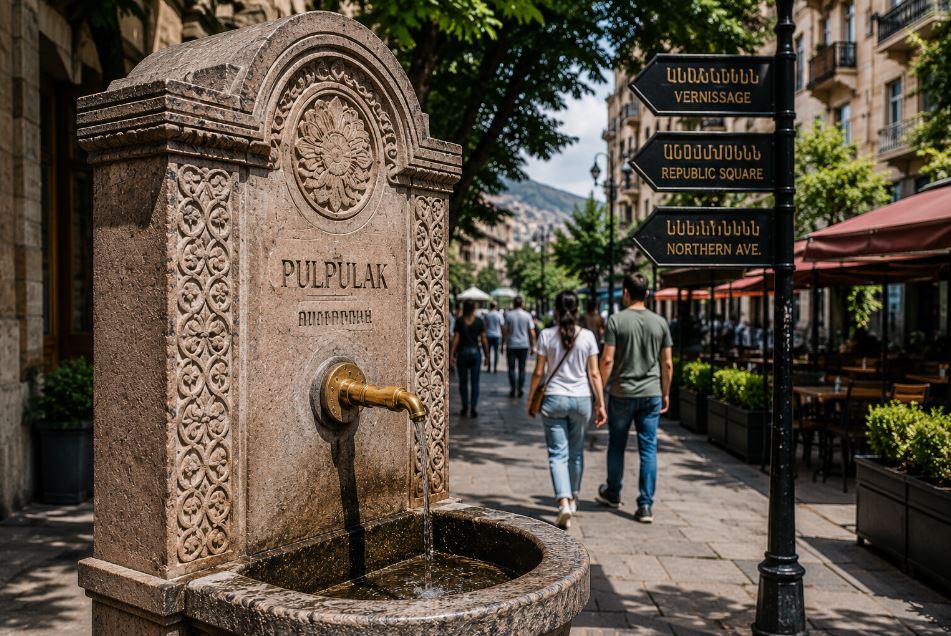
Pulpulaks are not limited to famous tourist areas. They can appear throughout the city, including:
- public parks and gardens;
- residential courtyards;
- areas near schools and sports grounds;
- busy pedestrian streets;
- older neighbourhoods;
- church grounds and memorial spaces;
- public squares and transport routes.
One reason visitors remember them is that they are often discovered unexpectedly. A traveller may encounter an ornate stone fountain beside a major landmark and later find a very simple one between apartment buildings.
There is no need to turn the search into a strict sightseeing route. The pleasure lies partly in noticing them as part of ordinary city life.
A Practical Answer to Yerevan’s Summer Heat
Yerevan summers are typically hot and dry. In July and August, long walks through the centre can quickly become tiring, particularly during the middle of the day.
Pulpulaks provide an immediate and environmentally sensible alternative to buying a new plastic bottle every time someone becomes thirsty.
For travellers, this can reduce both daily expenses and plastic waste. Carrying a small reusable bottle is still useful, but the presence of public drinking fountains means that water is often available during a walk.
The system is remarkably simple: a durable structure, running water and public access. There is no advertising, branding or complicated technology.
Why the Pulpulak Is Different From an Ordinary Drinking Fountain
Many cities have public drinking fountains, but Armenia’s pulpulaks are distinctive because of the cultural meaning that has developed around them.
They can serve several roles at once:
- a source of free drinking water;
- a piece of local architecture;
- a memorial to a person or event;
- a neighbourhood meeting point;
- a symbol of hospitality and shared public life.
That combination explains why Armenians often speak about pulpulaks with affection. They are useful, but usefulness alone does not explain their emotional importance.
A pulpulak can carry a family memory, display the work of a stone carver and help a stranger on a hot afternoon—all at the same time.
What the Pulpulak Reveals About Yerevan
Yerevan is often described through its large landmarks: Republic Square, the Cascade, the Opera House and views of Mount Ararat. Yet cities are also defined by the small systems that support everyday life.
The pulpulak is one of those systems.
It shows how public infrastructure can be practical without being anonymous. It demonstrates how remembrance can serve the living. Most importantly, it turns a basic necessity into a quiet act of generosity.
A visitor may drink from a pulpulak for only a few seconds. The experience is brief and may not appear important at the time. But later, when remembering Yerevan’s heat, stone buildings and long evening walks, the sound of cool water may become one of the clearest memories of the city.
A Small Piece of Advice for Travellers
When walking through Yerevan, do not look only at monuments and building façades. Pay attention to the small stone fountains beside pavements, parks and courtyards.
Check that the fountain is intended for drinking, lean toward the flowing water without touching the outlet and take a sip.
For a moment, you will be participating in an everyday Armenian tradition—one that combines water, craftsmanship, memory and hospitality in a single urban object.
The pulpulak may be small, but it tells one of Yerevan’s most generous stories.
Discover more from YEREVAN INFO
Subscribe to get the latest posts sent to your email.