When people imagine Yerevan, they usually picture pink tuff buildings, Republic Square, busy café terraces, the Cascade and, on a clear day, Mount Ararat rising beyond the city.
That image is real.
But there is another Yerevan hidden several levels below the streets — greener, rougher, quieter and surprisingly different from the capital above.
It is the Hrazdan Gorge.
The first time you look down into the gorge from one of Yerevan’s bridges, the contrast can feel almost confusing. Cars, apartment buildings and crowded streets are only minutes away, yet below them runs the Hrazdan River between steep slopes, old infrastructure, trees and pieces of Yerevan history that many visitors never notice.
If you have already seen the famous center and want to understand how unusual Yerevan’s geography really is, this is one of the places worth discovering.
A River Running Through the Capital
The Hrazdan River is not a decorative urban canal built for tourists. It is part of the natural geography that shaped Yerevan long before the modern capital grew around it.
The gorge cuts through the city and creates a completely different landscape from the wide avenues and stone architecture above.
From some viewpoints, Yerevan suddenly stops looking like a flat city.
You see steep walls, vegetation, bridges crossing high above the river and roads disappearing into the gorge.
It is one of those places that makes you understand something important about Armenia: even inside the capital, dramatic geography is never very far away.
Official Yerevan tourism information describes Hrazdan Gorge as one of the city’s distinctive natural landmarks and an important cultural, recreational and tourism area.
Why So Many Tourists Miss It
Hrazdan Gorge has an unusual problem: it is close to central Yerevan, but it does not always feel like part of the usual tourist route.
There is no single entrance where you buy a ticket and begin your visit.
There is no obvious “start here” sign.
Instead, the gorge appears in pieces.
You may first notice it while crossing a bridge. Later you discover a road descending toward the river. Somewhere else, an old structure suddenly appears between trees.
That fragmented character is exactly what makes the area interesting.
It does not feel designed around tourism.
You have to notice it.
The Bridges Change the Scale of Yerevan
One of the best ways to understand the gorge is from above.
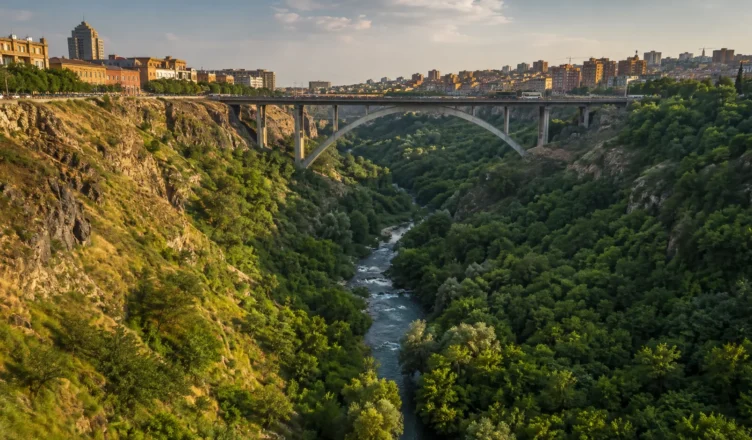
Several large bridges cross the Hrazdan River, and from them the depth of the landscape becomes obvious.
The Great Hrazdan Bridge, commonly known as Kievyan Bridge, stretches for hundreds of meters across the gorge and rises high above the river. According to Yerevan’s official tourism portal, the bridge is 364 meters long and reaches a height of more than 58 meters.
Another important structure is Victory Bridge, closer to the center. Its massive arches and elevated position help reveal how dramatically the terrain drops toward the river.
From street level, Yerevan can feel compact and manageable.
From these bridges, it suddenly feels much larger.
Look for the Old Aqueduct
One of my favorite details in the gorge is not a famous monument at all.
It is an aqueduct.
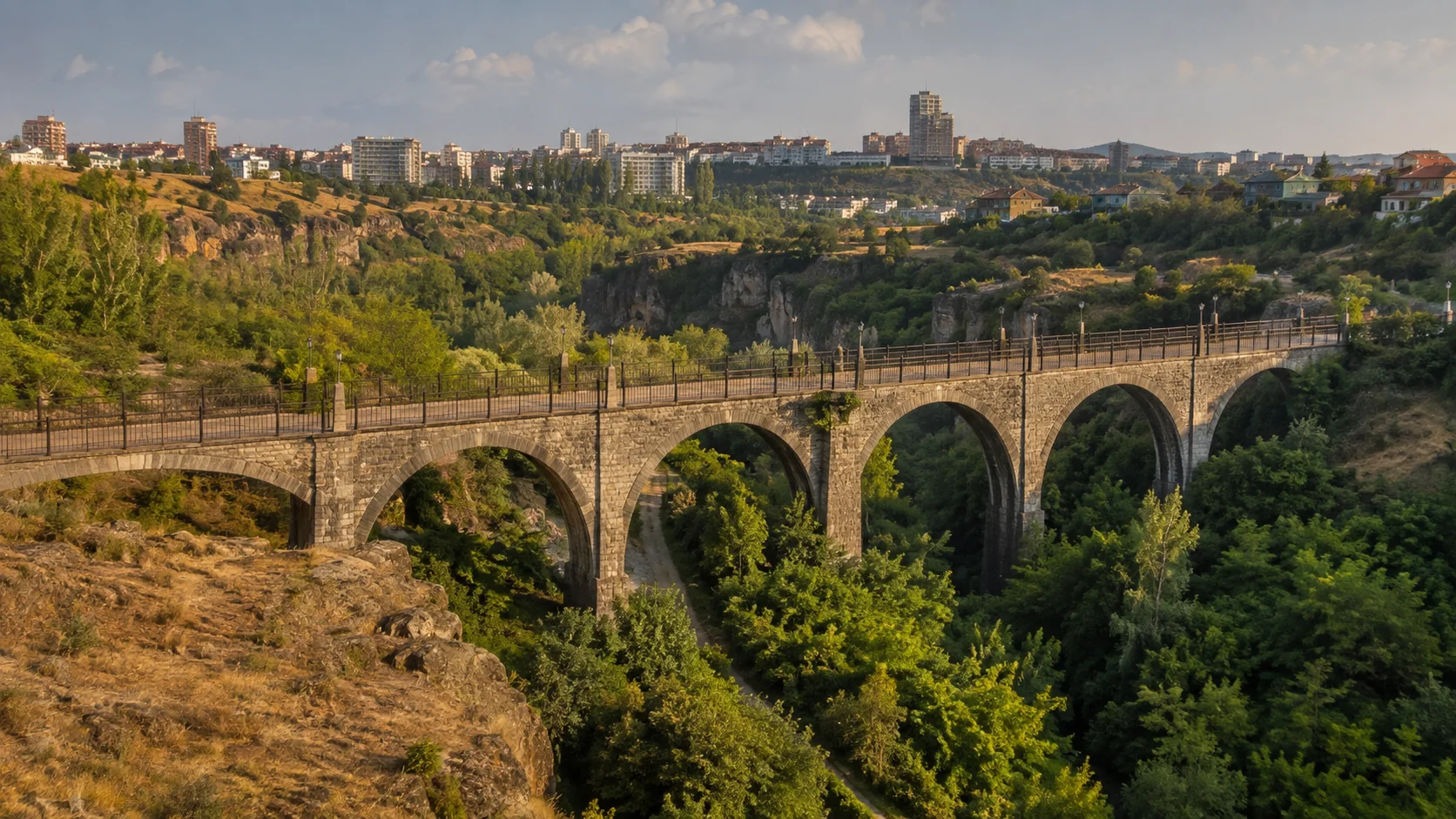
Built in 1950 and designed by Armenian architect Rafael Israelyan, the five-span structure crosses part of the gorge and blends unexpectedly well with the surrounding landscape. It also functions as a pedestrian crossing.
This is exactly the kind of place I enjoy finding in Yerevan.
It is practical infrastructure, architecture and scenery at the same time.
Visitors who only move between the city’s famous landmarks could easily spend several days in Yerevan without realizing it exists.
Yerevan’s Industrial History Is Here Too
The gorge is not only about nature.
It also contains traces of Yerevan’s transformation into a modern city during the twentieth century.
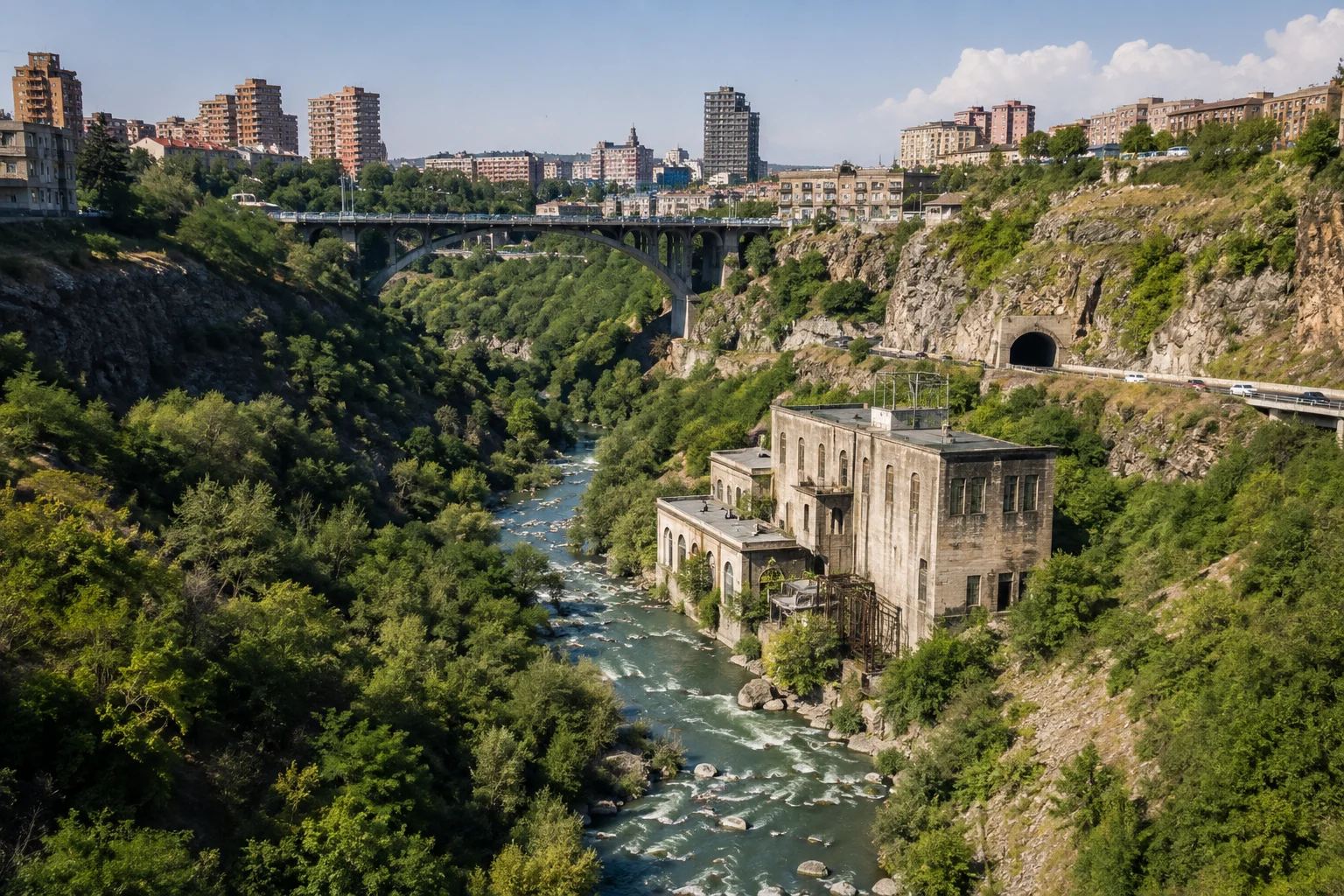
One example is Yerevan’s first hydroelectric power plant. Construction began in 1923 on the left bank of the Hrazdan River, making the gorge part of the story of the city’s early Soviet-era industrial development.
This creates one of the most interesting contrasts in the area.
You are looking at a natural river valley, but the landscape also contains bridges, water infrastructure, roads and engineering projects from different periods.
Rather than ruining the scenery, some of these structures have become part of its character.
The Children’s Railway Area Feels Like Another Era
Another distinctive part of the gorge is the historic Children’s Railway area.
For generations of Yerevan residents, this place has been connected with childhood memories, family walks and summer outings.
The railway environment — with its tracks, station architecture, tunnel and surrounding greenery — feels very different from central Yerevan.
Even without treating it as a conventional tourist attraction, the area is interesting because it preserves a piece of the city’s twentieth-century social history.
Nearby, you can also find an unusual black-tuff leopard sculpture installed on a rock in 1994, close to the railway tunnels.
It is the sort of detail you probably would never search for before visiting Yerevan.
Yet once you see it, you remember it.
The Gorge Has a Much Older Story
What makes Hrazdan Gorge even more fascinating is that its history does not begin with twentieth-century Yerevan.
Archaeological discoveries along the middle Hrazdan have revealed ancient cave settlements and Stone Age cultural remains. Yerevan Municipality notes that caves along the Hrazdan Gorge between Yerevan and Arzni contain evidence of human settlement dating back to very early periods.
That puts the landscape into a completely different perspective.
A modern capital now surrounds terrain where people lived thousands of years before the streets, apartment blocks and bridges existed.
In Yerevan, history often sits underneath modern life.
Here, that idea becomes almost literal.
Do Not Expect a Perfectly Polished Park
This is important.
Hrazdan Gorge should not be approached as though every part of it were a landscaped urban promenade.
Different sections feel very different from one another.
Some areas are recreational. Others contain roads or infrastructure. Certain paths may be uneven, isolated or simply inconvenient for casual visitors.
That is why I would not recommend entering an unfamiliar part of the gorge and simply walking indefinitely without checking where the route leads.
A better approach is to choose a particular section or landmark first and explore around it.
Good reference points include:
- viewpoints from major bridges;
- the historic Children’s Railway area;
- the aqueduct;
- established recreation areas;
- accessible riverside sections.
Wear comfortable shoes, carry water during hot weather and avoid assuming that every visible path is designed as a tourist walkway.
The Gorge Is Changing
Hrazdan Gorge is not frozen in the past.
Yerevan Municipality has been working on new recreational development in the area. A recently approved project envisions a 5.5-kilometer multifunctional recreational zone in the gorge, while another planned area in Arabkir includes landscaping, children’s and sports spaces and an open-air cinema.
That means future visitors may experience parts of the gorge differently from travelers today.
For me, this makes the area even more interesting to follow.
The challenge will be preserving its natural character while making it easier and more pleasant for people to use.
When to Visit
Spring and early autumn are probably the most comfortable seasons for exploring the gorge on foot.
During summer, Yerevan can become extremely hot, so early morning or later afternoon is usually much more pleasant than the middle of the day.
The gorge can feel cooler and greener than the surrounding streets, but that does not mean summer heat disappears.
After rain, unpaved areas may also become less convenient.
If photography is your priority, softer morning or evening light works beautifully here because the high slopes create strong contrasts between shadow and sunlight.
What to Bring
You do not need special hiking equipment for a short visit to accessible sections of the gorge, but I would bring a few simple things:
Comfortable shoes. This is not the place for planning a long walk in uncomfortable footwear.
Water. Especially from late spring through early autumn.
A charged phone. Useful for maps and finding the easiest route back toward the center.
A little extra time. Hrazdan Gorge is more enjoyable when it is not squeezed between two scheduled attractions.
And perhaps most importantly, bring some curiosity.
This is not a place where every interesting thing has a sign beside it.
How I Would Include It in a Yerevan Trip
I would not make Hrazdan Gorge the first place a newcomer sees in Yerevan.
For a first day, Republic Square, Abovyan Street, the Opera area and the Cascade make more sense. They introduce you to the city’s public face.
Then, after you think you understand Yerevan, visit the gorge.
That sequence makes the contrast much stronger.
Above: cafés, traffic, stone façades and busy sidewalks.
Below: river, steep slopes, bridges, old engineering structures and unexpected pockets of greenery.
It feels almost like discovering a second city underneath the first one.
A Different Kind of Yerevan Experience
Travel guides naturally focus on places that are easy to explain.
A cathedral has a name.
A museum has opening hours.
A square has recognizable architecture.
Hrazdan Gorge is harder to summarize.
It is a river valley, an urban landscape, an archaeological area, a recreation space and a collection of fragments from different periods of Yerevan’s history.
Perhaps that is why I find it so interesting.
It does not give you one perfect postcard.
Instead, it reveals how Yerevan actually grew around its geography.
Final Thought
If Republic Square shows Yerevan at its most formal and the Cascade shows it at its most panoramic, Hrazdan Gorge reveals something else: the city beneath the city.
It reminds you that Yerevan is not simply a collection of buildings placed on a plain.
It has valleys, slopes, water, old roads, bridges and layers of history hidden surprisingly close to everyday urban life.
Many visitors will leave Armenia without ever walking down toward the Hrazdan River.
That is perfectly understandable.
But if you have an extra half-day and want to see a side of Yerevan that feels less predictable, look down from one of the bridges.
There is another city waiting below.
Discover more from YEREVAN INFO
Subscribe to get the latest posts sent to your email.