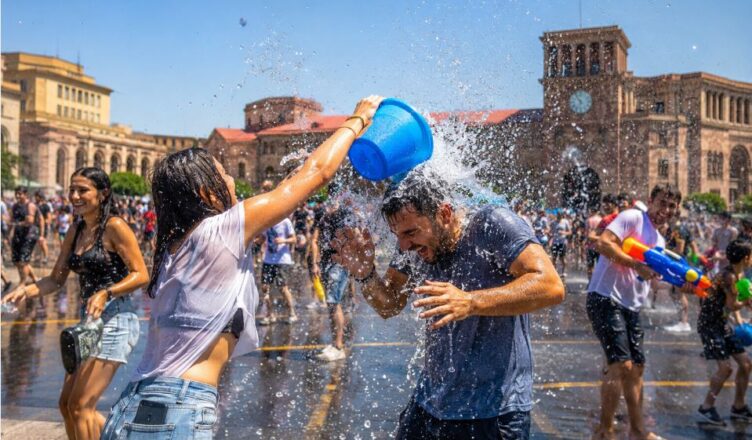
I thought I was simply going for a quiet Sunday walk through Yerevan. Ten minutes later, I was standing in the middle of the street, completely soaked, holding my shoes in one hand and laughing with people whose names I did not even know.
That was how I discovered Vardavar — not through a guidebook, a museum or a carefully planned excursion, but through a bucket of cold water poured over my head by a smiling Armenian boy.
It was July 12, and Armenia was celebrating one of its most joyful and unusual holidays.
A suspiciously quiet morning
My morning began peacefully. The summer sun was already warming the pale pink buildings of central Yerevan, cafés were opening their doors, and the city seemed to be moving at its familiar relaxed Sunday rhythm.
As I left my accommodation, the receptionist looked at my clothes, then at the phone in my hand.
“Be careful today,” she said with a smile.
I assumed she meant the heat.
She pointed at my phone and added:
“Put that in a plastic bag.”
I still did not understand.
Outside, however, I began noticing clues. Children were carrying colourful water guns. Teenagers stood beside large buckets. Several adults were filling bottles from public drinking fountains, although they did not appear particularly thirsty.
Then I turned a corner.
A stream of water flew through the air and hit me directly across the shoulder.
I stopped in surprise. A little boy froze, still holding an empty plastic container. For a moment, we simply stared at each other.
Then his mother laughed, the boy laughed, and — despite my wet shirt — I began laughing too.
“Vardavar!” they shouted.
The moment the entire city became a playground
Within half an hour, Yerevan no longer looked like the calm capital I had explored the previous day.
Its streets had turned into an enormous open-air water battle.
Children chased one another around courtyards. Young people ran with buckets and water pistols. Water occasionally fell from balconies, followed by laughter from somewhere above. Drivers slowed down near groups of children, knowing perfectly well what was about to happen.
No one seemed completely safe — not tourists, not carefully dressed pedestrians and not even people who tried to hide behind trees.
At first, I attempted to remain dry.
This was my first mistake.
I walked close to the walls, avoided large groups and tried to look like someone who urgently needed to reach an important meeting. None of these strategies worked.
Two young women approached me near a small park. One of them raised a bottle of water and asked in English:
“Can we?”
I appreciated the politeness, but before I had decided how to answer, her friend gently poured water over my arm.
A few streets later, resistance had become pointless. My clothes were wet, my hair was dripping, and water was making strange noises inside my shoes.
Strangely, I no longer cared.
A celebration without strangers
What surprised me most was not the amount of water. It was the way the holiday seemed to remove the invisible barriers that normally exist between people.
On an ordinary day, strangers might pass each other without speaking. During Vardavar, everyone appeared to become part of the same enormous game.
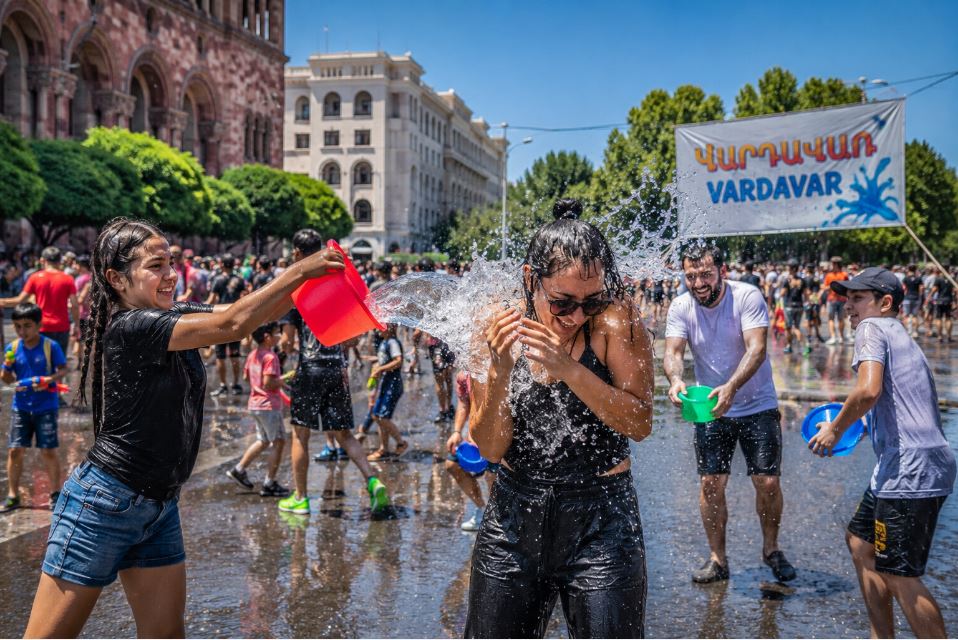
Children splashed adults. Adults answered with their own buckets. Neighbours leaned over balconies. Friends formed small teams. Tourists who had looked confused only minutes earlier were soon filling bottles and joining the celebration.
Age, language and social status suddenly seemed unimportant.
A grandmother sitting near the entrance of an apartment building watched a group of teenagers running past. I expected her to complain about the noise. Instead, she picked up a small bowl of water she had apparently prepared in advance and threw it at them.
The teenagers cheered.
She looked extremely pleased with herself.
Republic Square under a shower of laughter
As I moved closer to Republic Square, the celebration became louder and more energetic.
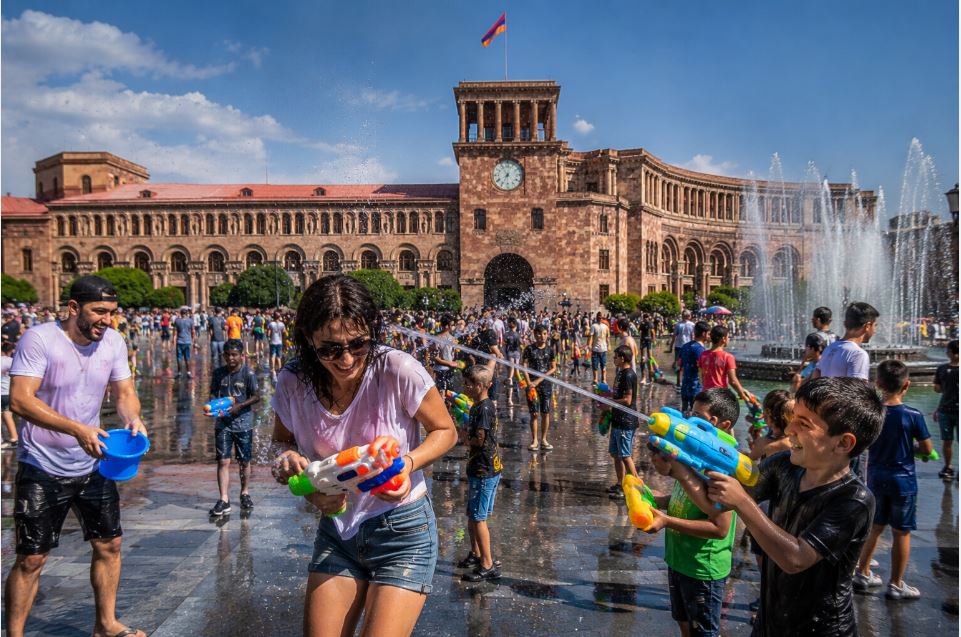
Music could be heard from a distance. Families, groups of friends and curious visitors were moving toward the centre. Some people carried brightly coloured water guns, while others arrived with ordinary bottles, buckets or whatever containers they had been able to find.
The elegant buildings surrounding the square formed a striking background to the chaos below. Water glittered in the sunlight. Children ran through the crowds. Music mixed with shouting and laughter.
Every few seconds, someone nearby was hit by another wave of water.
I saw a tourist carefully taking photographs from what he apparently believed was a safe distance. A group of children noticed him. He noticed them noticing him.
For several seconds, neither side moved.
Then the tourist quickly placed his camera inside his bag, opened his arms and accepted the inevitable.
A bucket of water followed.
He laughed so loudly that everyone around him began laughing too.
More than a giant water fight
At first glance, Vardavar may seem like nothing more than a nationwide water festival. Yet behind the playful modern celebration is a tradition with deep historical and spiritual meaning.
Today, the Armenian Apostolic Church celebrates Vardavar as the Feast of the Transfiguration of Jesus Christ, one of the five major feasts of the Armenian Church.
According to the Gospel story, Christ went up a mountain with the apostles Peter, James and John. While praying, His appearance changed: His face shone and His clothes became brilliantly white. The apostles witnessed this moment of divine revelation.
The feast is celebrated fourteen weeks, or ninety-eight days, after Easter and therefore falls on a different date each year.
Vardavar also carries traces of Armenia’s pre-Christian past. The ancient celebration is commonly connected with Astghik, the Armenian goddess associated with love, beauty and water. Over the centuries, older customs became intertwined with the Christian feast, allowing the symbolic role of water to survive.
This combination of ancient tradition, Christian faith and modern street celebration makes Vardavar unlike any festival I had experienced before.
How Armenians explained the meaning to me
Later in the afternoon, I stopped at a small café. The staff had wisely removed some of the outdoor cushions, although the floor was already covered with wet footprints.
I asked a local man why people continued celebrating the holiday with such enthusiasm.
“Water means life,” he replied. “And today people become children again.”
His answer seemed simple, but it described exactly what I had witnessed.
Vardavar was not only about throwing water. It was about permission — permission to laugh loudly, to forget formality, to speak to strangers and to behave with the freedom of childhood for one summer day.
There was something wonderfully democratic about it. Expensive clothes offered no protection. Serious expressions did not survive for long. Everyone eventually became equally wet.
What tourists should know before experiencing Vardavar
Travellers visiting Armenia during Vardavar should prepare for one unavoidable fact: remaining completely dry is highly unlikely.
Keep your phone, documents, money and camera in waterproof bags. Wear light clothes that dry quickly and choose shoes that will not be damaged by water. Carrying an extra shirt can also be useful.
It is best not to bring expensive electronics into the busiest celebration areas unless they are properly protected.
At the same time, visitors should remember that the holiday is meant to be joyful rather than aggressive. Young children, elderly people and anyone carrying delicate equipment should be treated thoughtfully. Busy roads also require caution, even when everyone around you is celebrating.
Most importantly, do not become angry when the first splash arrives.
That first bucket is your invitation.
The Armenia I will remember
By evening, the streets were beginning to calm down. Wet pavements reflected the warm light, exhausted children carried empty water guns home, and groups of friends continued laughing as they walked through the city.
I returned to my room in clothes that felt twice as heavy as they had that morning.
My original plan had been to visit a museum, drink Armenian coffee and spend a quiet afternoon photographing Yerevan’s architecture.
Instead, I had been chased through a park by children, attacked from a balcony, handed a bucket by complete strangers and welcomed into a celebration I had known almost nothing about when I woke up.
Yet that unplanned day revealed something important about Armenia.
Traditions here are not always kept behind museum glass. Some of them walk into the streets, fill the squares and pour an entire bucket of cold water over your head.
Vardavar showed me an Armenia that was playful, open, ancient and unexpectedly young at heart.
And although I spent most of the day completely soaked, it became one of the warmest memories of my journey.
Discover more from YEREVAN INFO
Subscribe to get the latest posts sent to your email.