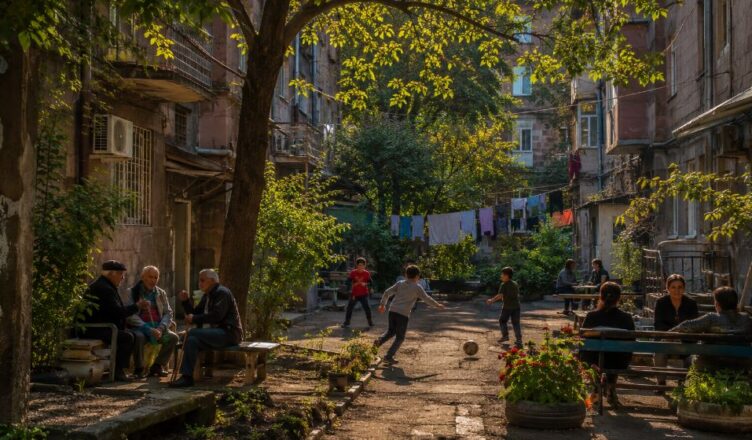
Yerevan is often introduced through its famous landmarks: Republic Square, the Cascade, Northern Avenue, museums, churches, cafés, and mountain views. But behind the main streets and apartment buildings, there is another Yerevan — quieter, more personal, and deeply human. It is the world of courtyards.
For many locals, the courtyard is not just an empty space between buildings. It is a small social universe where childhood memories, neighborhood friendships, daily conversations, and old traditions continue to live. To understand the real rhythm of Yerevan, it is worth looking beyond the façades and stepping into these hidden spaces behind the apartment blocks.
Why Courtyards Matter in Yerevan
In many older districts of Yerevan, courtyards have always been more than a practical part of urban design. They became meeting places, playgrounds, quiet gardens, and informal community centers. Before smartphones, shopping malls, and endless online communication, the courtyard was where people learned to socialize, argue, help each other, and belong.
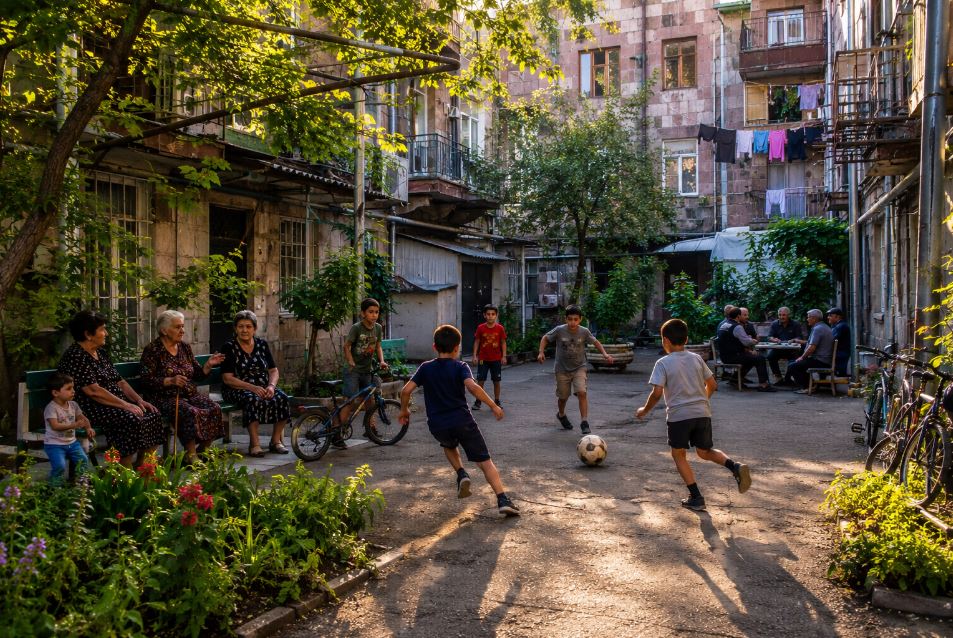
Children played football there until sunset. Elderly neighbors sat on benches and discussed everything from family news to politics. Someone always knew who was sick, who needed help, who had guests, and who had just returned from abroad. The courtyard created a sense of connection that no modern building entrance can fully replace.
A Social World Hidden Behind Buildings
For visitors, these courtyards may seem ordinary at first glance. There may be a few benches, trees, parked cars, balconies full of laundry, cats sleeping in the shade, and children running around. But for locals, every corner can hold a memory.
One bench may be where grandparents spent long summer evenings. A small tree may have been planted by a resident decades ago. A wall may still carry traces of children’s games. A simple metal gate may open into a place where several generations grew up together.
This is why Yerevan courtyards are emotionally important. They are not designed as tourist attractions, but they preserve something that many polished city centers lose — everyday human warmth.
Childhood in the Courtyard
For many people who grew up in Yerevan, childhood is inseparable from the courtyard. It was the first football field, the first stage, the first school of friendship, and sometimes the first place where a child learned how to solve conflicts.
Children from different apartments often became almost like family. Parents watched them from balconies, calling them home for dinner. In summer, the courtyard could stay alive until late evening, filled with voices, laughter, bicycle wheels, and the sound of a ball hitting the wall.
Even today, in some neighborhoods, this atmosphere still exists. Although modern life has changed many habits, the courtyard remains one of the few places where children can still experience a more open and communal form of city life.
The Role of Older Generations
One of the most recognizable images of Yerevan courtyards is the group of elderly residents sitting outside in the afternoon. They observe the life of the neighborhood with quiet attention. They know who lives where, whose children have grown up, and what has changed over the years.
For them, the courtyard is a place of memory and belonging. It is where they meet familiar faces, exchange news, and feel that they are still part of the living rhythm of the city. In many ways, these people are the keepers of courtyard culture.
Their conversations may seem simple, but they form an invisible network of care. If someone needs help, the neighbors often know before anyone asks. This kind of informal support is one of the most valuable parts of Yerevan’s courtyard life.

Old Districts and New Realities
The courtyard culture of Yerevan is especially visible in older neighborhoods such as Arabkir, Kentron, Nor Nork, Shengavit, and parts of Ajapnyak. Many buildings from the Soviet period were designed with inner yards that naturally encouraged social interaction.
In newer residential complexes, the situation is often different. Modern buildings may have cleaner entrances, underground parking, security systems, and landscaped areas, but they do not always create the same sense of community. People may live close to each other physically, yet remain distant socially.
This contrast shows how urban design can influence human relationships. A courtyard is not only about space. It is about how people use that space, how often they meet, and whether they feel comfortable enough to speak to one another.
Small Gardens, Balconies, and Everyday Beauty
Many Yerevan courtyards have their own small signs of care. Someone plants roses near the entrance. Someone waters a tree every morning. Someone places old chairs outside for neighbors. Balconies become colorful with flowers, carpets, and laundry moving in the wind.
These details may look ordinary, but they create a special atmosphere. They show that people do not simply live in these buildings — they leave personal traces on the environment around them. This is one of the reasons why Yerevan’s courtyards feel warm and alive.
Why Tourists Rarely See This Side of Yerevan
Most travelers explore Yerevan through its central streets, restaurants, museums, and viewpoints. These places are important, but they show only one side of the city. Courtyards reveal another layer — the private, everyday, emotional Yerevan.
Of course, visitors should be respectful. Courtyards are not museums; they are living spaces. But simply noticing them while walking through different neighborhoods can change the way one sees the city. Behind every building there may be a story that never appears in travel guides.
The Future of Courtyard Culture
As Yerevan continues to change, courtyard culture faces new challenges. More cars fill the spaces where children once played. New construction changes the scale of neighborhoods. People spend more time indoors and online. Some old courtyards are slowly losing their social role.
Yet the memory of this culture remains strong. Many residents still value the idea of knowing their neighbors, sharing space, and creating a small community inside a large city. If preserved and respected, courtyards can continue to be one of Yerevan’s most meaningful urban traditions.
Conclusion
To truly understand Yerevan, one must look not only at its monuments, cafés, and main squares, but also at the spaces hidden behind apartment blocks. The courtyards of Yerevan tell stories of childhood, friendship, patience, memory, and everyday kindness.
They remind us that a city is not made only of buildings and streets. It is made of people who greet each other, children who play together, neighbors who remember one another, and small places where life quietly continues day after day.
That is why Yerevan’s courtyard culture remains one of the city’s most honest and touching treasures — hidden in plain sight, behind the walls of ordinary apartment blocks.
Discover more from YEREVAN INFO
Subscribe to get the latest posts sent to your email.