
Yerevan is not only understood through monuments, museums, restaurants, or travel guides. The real character of Armenia’s capital appears in small everyday rituals: the slow morning coffee, the evening walk, the neighborhood bakery, the quiet conversation on a bench, the way people greet each other, and the unhurried rhythm that makes the city feel deeply human.
Many visitors arrive in Yerevan with a list of places to see: Republic Square, the Cascade, Vernissage, the Opera area, the view of Mount Ararat, museums, churches, and restaurants. These places are important, and they tell part of the story. But they do not explain everything.
To understand Yerevan, you need to notice the small things.
You need to see how the city wakes up slowly in the morning, how people stop to talk in the street, how coffee can turn into a two-hour conversation, how evenings bring families, couples, students, and older residents into the same public spaces. Yerevan is a capital city, but it often behaves like a large neighborhood. That is part of its charm.
Morning begins with coffee, not hurry
In many cities, morning coffee is just fuel. In Yerevan, it is closer to a ritual. Even on busy days, people try to create a small pause around it. Coffee can be prepared at home, ordered in a small café, or enjoyed at work before the real day begins.
This habit says a lot about the city. Yerevan does not always rush into the day. It stretches into it. A morning coffee is not only about taste; it is about mood, conversation, and a sense of beginning.
For visitors, this is one of the easiest ways to feel the local rhythm. Instead of grabbing a drink and leaving immediately, sit for a little longer. Watch the street. Listen to the language around you. Let the city move at its own pace.
The neighborhood bakery is part of daily life
Food culture in Yerevan is not limited to restaurants. Some of the most meaningful everyday experiences happen around small bakeries, grocery shops, fruit stands, and places where people buy something simple on the way home.
The smell of fresh bread can change the atmosphere of an entire street. A small bakery can become a familiar point in the neighborhood. People remember where the bread is warmest, where the service is friendliest, and where they can stop for something quick without feeling like strangers.
This is one of the reasons Yerevan feels personal. Daily life is still connected to real places and real people. Even in a modern city, small local habits remain strong.
Evening walks are a social tradition

One of the most beautiful everyday rituals in Yerevan is the evening walk. As the heat softens and the city lights begin to glow, people come outside. Families walk together. Friends meet without rushing. Older residents sit on benches. Children run near fountains or open squares.
This is not just recreation. It is a form of public life.
In the evening, Yerevan becomes more open and expressive. The city feels warmer, louder, softer, and more collective at the same time. The same streets that seem practical during the day become emotional after sunset.
For travelers, an evening walk can reveal more than a planned tour. You see how people actually use the city. You understand where they gather, how they relax, and why public space matters so much here.
Conversations often last longer than planned
In Yerevan, a short meeting can easily become a long conversation. People may stop each other in the street, talk at café tables, continue discussions near apartment entrances, or turn a quick errand into a social moment.
This does not mean everyone has unlimited time. It means communication has emotional value. Talking is not only an exchange of information; it is a way of keeping relationships alive.
For foreigners or newcomers, this may feel surprising at first. But after some time, it becomes one of the city’s most memorable qualities. Yerevan is built not only from stone, tuff, and streets, but also from conversations.
Hospitality appears in small gestures
Armenian hospitality is often described through large meals and generous tables. That is true, but in Yerevan hospitality also appears in smaller ways: someone giving directions with extra care, a neighbor asking if everything is fine, a shopkeeper remembering your face, a stranger helping you understand which minibus or taxi direction makes sense.
These gestures may seem ordinary, but they create the emotional texture of the city. They make Yerevan feel less anonymous than many larger capitals.
Of course, the city is changing. It is becoming more international, busier, and more modern. But this everyday warmth still remains one of its strongest cultural markers.
The city has a strong bench culture
Benches in Yerevan are not just urban furniture. They are small social stages. In parks, courtyards, squares, and shaded streets, benches become places for rest, observation, conversation, and quiet routine.
Older residents often use them as part of daily life. Friends meet there. Parents watch children play. Someone sits alone and simply looks at the city. These scenes may not appear in tourist brochures, but they are essential to the atmosphere of Yerevan.
A bench can show you the city’s pace better than a landmark. It teaches you that not every meaningful travel moment requires movement.
Markets show the city’s practical soul
Markets and small food shops reveal another side of Yerevan. Here the city becomes direct, practical, colorful, and alive. Seasonal fruits, herbs, dried fruits, cheese, bread, spices, and everyday conversations create an atmosphere that feels both local and timeless.
Even if you are not planning to buy much, walking through a market helps you understand how people live, cook, choose, bargain, and communicate. It is one of the simplest ways to experience culture without turning it into a museum.
Yerevan’s beauty is not only in architecture. It is also in apricots arranged on a stand, herbs wrapped in paper, and a seller explaining which fruit is sweetest today.
Courtyards keep memories alive
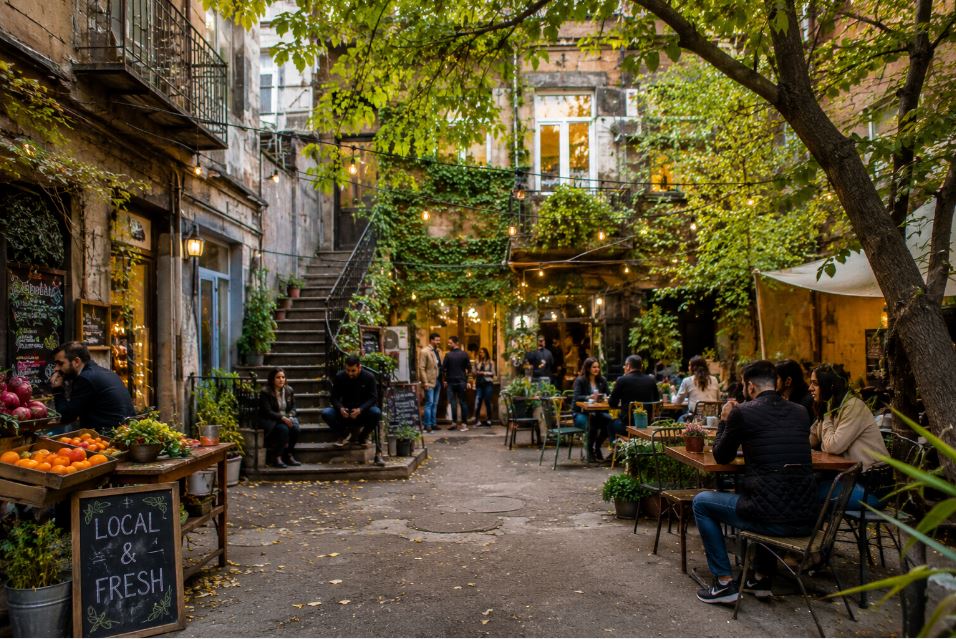
Yerevan’s courtyards are another important part of everyday culture. Some are quiet and green, others are crowded with parked cars, children’s bicycles, laundry, cats, and neighbors who have known each other for years.
These courtyards carry memories of older city life. They are places where generations meet, where children grow up under the eyes of many adults, and where private and public life gently overlap.
For visitors, courtyards may seem ordinary. For locals, they can be deeply emotional spaces connected to childhood, family, friendship, and neighborhood identity.
Yerevan’s rhythm changes by season
Everyday rituals in Yerevan are strongly connected to the seasons. Spring brings longer walks, flowers, outdoor cafés, and a feeling of renewal. Summer pushes life into the evening because daytime heat can be intense. Autumn gives the city a softer light and a more poetic mood. Winter slows everything down and makes indoor gatherings more important.
This seasonal rhythm helps explain why the same street can feel different throughout the year. Yerevan is not a city with one fixed mood. It changes with light, weather, holidays, and social energy.
To understand the city well, it is worth seeing not only its places, but also its timing.
Modern life is changing the rituals, but not removing them
Yerevan today is more modern than many visitors expect. New cafés, creative spaces, residential buildings, coworking offices, galleries, and restaurants continue to change the city’s lifestyle. Younger generations move faster, work differently, travel more, and use digital tools naturally.
But even with these changes, many old habits remain. People still value face-to-face meetings. Family ties remain strong. Food still gathers people around the table. Evening walks still matter. Coffee still invites conversation.
This mix of old and new is one of Yerevan’s most interesting cultural features. The city is not frozen in tradition, but it has not lost its emotional habits either.
How visitors can experience Yerevan more deeply
If you want to experience Yerevan beyond the standard route, slow down. Do not fill every hour with sightseeing. Leave time for ordinary moments.
Have coffee without checking the clock. Walk in the evening without a strict destination. Visit a bakery. Sit on a bench. Notice how people greet each other. Spend time in a neighborhood, not only in the main tourist areas. Try to understand not only what the city shows, but how it lives.
Yerevan rewards attention. The more you notice, the more the city opens.
Final thought
Yerevan’s everyday rituals may seem small, but together they create the city’s soul. Coffee, bread, benches, courtyards, evening walks, markets, and long conversations are not background details. They are part of what makes the Armenian capital feel warm, personal, and unforgettable.
Landmarks help you see Yerevan. Everyday rituals help you feel it.
And perhaps that is the best way to understand this city: not by rushing through it, but by letting its small daily habits slowly become part of your own memory.
Discover more from YEREVAN INFO
Subscribe to get the latest posts sent to your email.